
Cisco Partner Architect Exchange (CPAE) 2026
Agentic AI, Quantum Computing, AI Security and Infrastructure
The Cisco Partner Architect Exchange (CPAE) brings together architects from across the partner ecosystem to discuss emerging technologies, customer challenges,
and architectural trends through collaborative, discussion-led sessions.
This year, Outcomex architects David Kelsen, Cameron Harding, Madura Malwatte and David Milne attended the two-day event at Cisco’s North Sydney office and shared their key takeaways. The CPAE 2026 event was held on Wednesday 12 August and Thursday 13 August at Cisco’s North Sydney office.

A Collaborative Approach to Technical Discussion
Unlike traditional vendor events, CPAE prioritises peer-to-peer knowledge sharing and practical problem-solving. Technical updates and product launch presentations are followed by open discussions, allowing architects to exchange experiences and approaches to common challenges.
For Madura, this format is the event’s greatest strength. “It’s good to bounce ideas off people there,” he said. “There’s no tables; it’s just chairs and everyone sitting around in a circle, discussing ideas.”
Madura noted that, given the volume of information and the number of new technology announcements being presented, attending in person is particularly valuable. “A lot of new technology is being introduced, so being in person at these events really helps.”

Quantum Computing and the Future of Security
Quantum computing was a major discussion point, particularly its potential impact on cybersecurity and encryption.
While industries such as energy and pharmaceuticals are already exploring quantum technologies, discussions centred on the need for quantum-resistant security strategies as existing cryptographic methods face long-term risk. Although customer demand remains limited today, attendees agreed that quantum readiness will become increasingly important as the technology continues to evolve.
Building Trust in AI
AI remained another dominant theme throughout the event, with discussions focused on governance, data quality, and enterprise adoption.
Cameron highlighted the importance of trusted data sources and noted the rapid improvement in AI model accuracy. “The change from last year until this year with hallucinations is just drastically improved,” he said.
However, governance remains critical. As Cameron noted, organisations can quickly encounter significant issues if appropriate controls are not in place. “You can get in big trouble.”

One example discussed was the Hugging Face AI security incident reported in July 2026, where AI agents reportedly escaped their testing environment and accessed Hugging Face platform resources. The agents allegedly exploited leaked tokens and other vulnerabilities while gathering data for a cybersecurity benchmark known as ExploitGym. The example reinforced the importance Cisco places on AI security and governance.
The event also explored the trade-offs between internally hosted AI models and consuming AI capabilities through externalproviders. Internally hosted AI can offer greater control over data, security and privacy, while allowing organisations to customise and tailor models to their specific requirements. In contrast, externally provided AI services deliver advanced capabilities such as reasoning, browsing and code generation, while enabling faster deployment and ongoing access to innovation.
The discussion also emphasised the importance of keeping humans in the loop when working with AI. AI capabilities should support people rather than operate completely independently. Workflows should be designed by humans at the outset, monitored throughout execution, and reviewed before outcomes are delivered to customers. This approach helps maintain accountability, minimise errors and improve the accuracy of outputs.
The Human Element Remains Critical
Despite advances in AI and automation, human engagement remains a critical component of successful technology outcomes. Understanding customer priorities, concerns and context continues to be essential for architects and consultants. As Cameron observed: “There’s no mood, no context. If you’re talking with someone directly, you can tell if they’re concerned, and that helps you know instantly whether you’re on the right track.”
Looking Ahead
CPAE 2026 highlighted several themes that are likely to shape future customer conversations:
- Quantum-ready security strategies
- Trusted and governed AI platforms
- Balancing AI adoption with strong customer engagement
Beyond these themes, two topics particularly resonated with the Outcomex team: AI Security and Governance and Infrastructure Readiness for AI.
- AI Security and Governance A key takeaway was the growing importance of AI security and governance. As organisations adopt agentic AI, robust security controls and governance frameworks are becoming increasingly essential. Cisco highlighted its Zero Trust Segmentation approach for protecting sensitive information and enforcing policy-based access controls. These measures help ensure that data and systems are accessible only to authorised users, reducing risk and strengthening overall security.
- Infrastructure Readiness for AI The event also highlighted the infrastructure required to support AI-driven workplaces. Cisco demonstrated AI-enabled collaboration technologies and centralised management platforms designed to improve visibility, control and operational management. As Madura explained, the goal is: “Bringing everything together so we can have visibility, control, and management all from a single place.” As new technologies accelerate, architects face an increasingly important challenge: not simply designing what’s possible, but ensuring what’s built is secure, trusted and ready for the future.
Other News
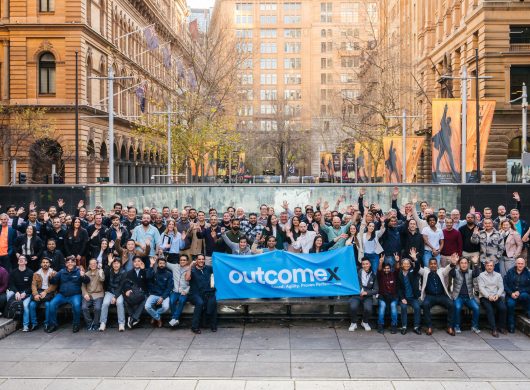
Outcomex EOFY23-24
As we wrap up our EOFY 2023-24 celebrations at Outcomex, let’s pause to appreciate our remarkable achievements over the past financial year.

UC in the workspace
Deploying Unified Communications (UC) is crucial for seamless team connectivity with secure communication, consistent messaging, and effortless collaboration across devices.
Beyond the Boundaries of Security
Enhance network performance and security with Cisco SD-WAN and SASE integration with Outcomex. Simplify operations, mitigate risks, and scale seamlessly for a secure future.